
Examples
Compression and conditioning of a CO₂-rich stream containing impurities for geological storage. The CO₂ is compressed in three stages with intermediate cooling using cooling water, followed by final booster compression and cooling to reach the conditions required for injection. The compressed stream is subsequently sent to a CCS well for injection into an underground reservoir. The example illustrates multistage compression, intercooling and the handling of non-pure CO₂ streams in CCS applications.
 Open
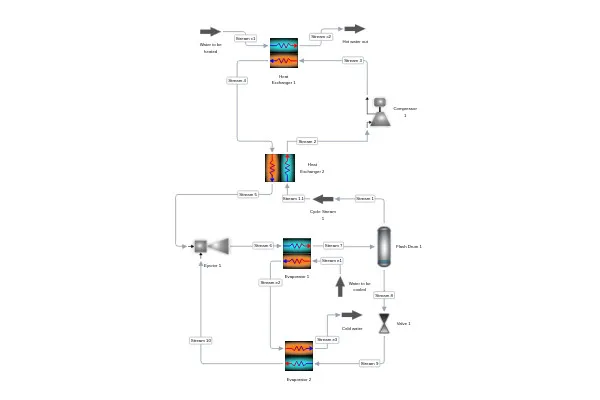
OpenHeat pumps transfer heat from a low-temperature heat source to a higher-temperature heat sink and are widely used for space and water heating, industrial heat recovery, and simultaneous heating and cooling. CO₂ (R744) is a natural refrigerant with attractive thermodynamic and environmental properties for many heat-pump applications. This example demonstrates an advanced CO₂ vapor-compression heat pump incorporating an internal heat exchanger (IHX), an ejector, a flash drum, and two evaporators. The ejector uses the pressure energy of the high-pressure refrigerant to entrain a lower-pressure CO₂ stream, recovering part of the energy that would otherwise be lost during throttling. The flash drum separates the refrigerant streams and supplies liquid CO₂ to the lower evaporator through an expansion valve, while vapor is returned toward the compressor. The two evaporators provide cooling at different locations in the cycle, while the compressed CO₂ transfers heat to the hot-water stream, completing the heat-pump cycle.
 Open
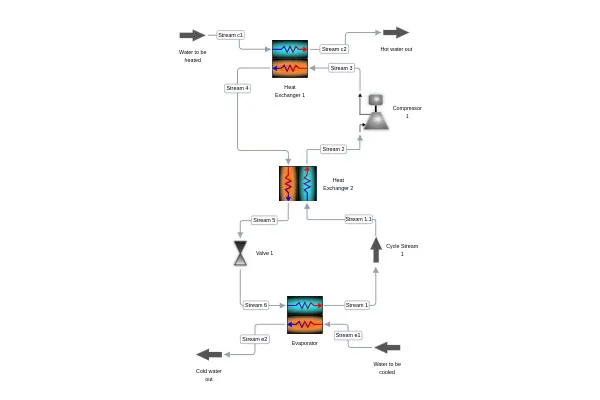
OpenHeat pumps transfer heat from a low-temperature heat source to a higher-temperature heat sink and are widely used for space and water heating, industrial heat recovery, and simultaneous heating and cooling. CO₂ (R744) is a natural refrigerant with attractive thermodynamic and environmental properties for many heat-pump applications. This example demonstrates a CO₂ vapor-compression heat pump with an internal heat exchanger (IHX). The IHX transfers heat between the high- and low-pressure sides of the refrigerant loop, cooling the high-pressure CO₂ before expansion while heating the low-pressure CO₂ before compression. CO₂ absorbs heat from a water stream in the evaporator, is compressed to a higher pressure and temperature, and then transfers heat to a second water stream. The refrigerant subsequently passes through the IHX and expansion valve before returning to the evaporator, completing the cycle.
 Open
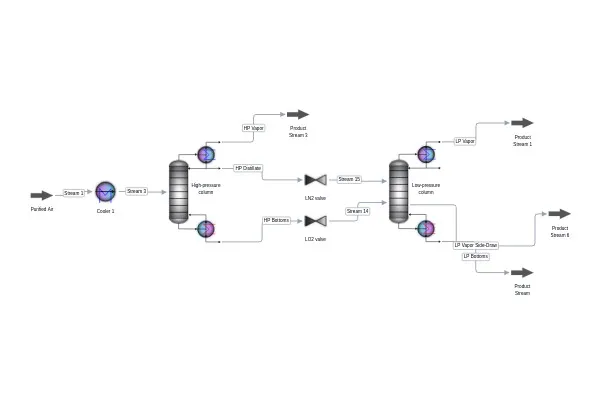
OpenA simplified cryogenic air separation unit (ASU) for the production of oxygen and nitrogen. Purified air is cooled and separated in a high-pressure distillation column, after which liquid streams are expanded to a low-pressure column for further separation. The two-column process exploits the different volatilities of nitrogen and oxygen to produce nitrogen-rich and oxygen-rich product streams. The example illustrates cryogenic distillation, pressure coupling and multicolumn separation.
 Open
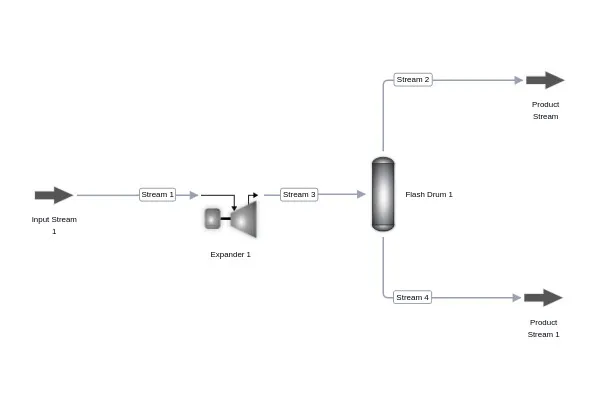
OpenA CO₂-containing stream is expanded to conditions where solid CO₂ (dry ice) forms directly within the process simulation. The downstream separator calculates the solid–fluid phase equilibrium, with solid CO₂ leaving in the bottom stream while the remaining gas continues according to the equilibrium conditions. The solid-formation model has been carefully validated against experimental data and gives excellent agreement for both pure CO₂ and mixtures, illustrating fully integrated prediction of solids in TP-Process.
 Open
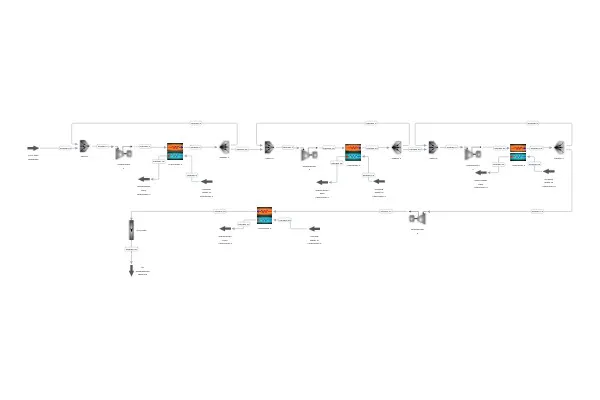
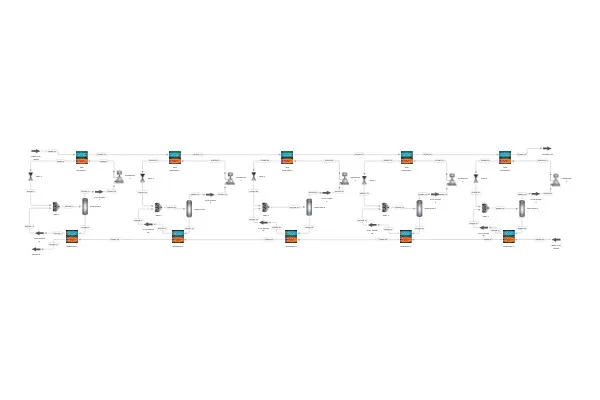
OpenHeat pumps transfer heat from a low-temperature heat source to a higher-temperature heat sink and are widely used for space and water heating, industrial heat recovery, and simultaneous heating and cooling. Ammonia (R717) is a natural refrigerant with excellent thermodynamic properties and is widely used in large industrial refrigeration and heat-pump systems. This advanced example demonstrates five flooded ammonia heat-pump cycles connected in series. Each cycle contains its own compressor, heat exchanger, expansion valve, flash separator, and flooded evaporator. The water streams pass successively through the five heat-pump stages, allowing the heating and cooling duties to be distributed across several temperature levels rather than handled by a single cycle. In each flooded evaporator, excess liquid ammonia keeps the heat-transfer surface well wetted while the flash separator separates vapor from the remaining liquid. The arrangement illustrates how several heat-pump modules can be combined to achieve a large overall temperature lift while maintaining favorable operating conditions in each individual cycle.
 Open
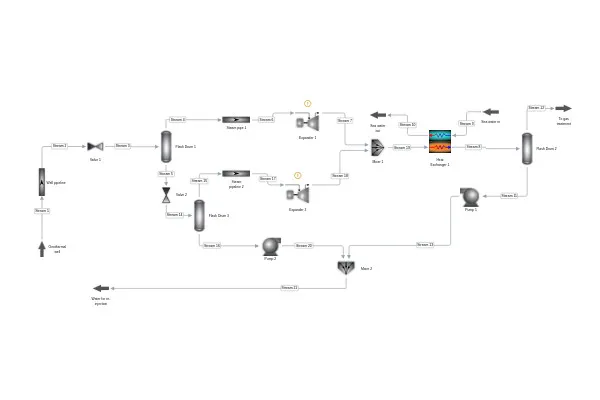
OpenProcessing of geothermal well fluid from an Icelandic geothermal reservoir. The produced fluid is depressurized through multiple flash stages to separate steam from the liquid phase. The steam streams are expanded to generate power, while residual heat is rejected using water cooling. Non-condensable gases are separated and sent to gas treatment, and the remaining geothermal water is collected for reinjection into the reservoir. The example illustrates multiphase flashing, power generation, heat rejection and fluid reinjection in a geothermal process.
 Open
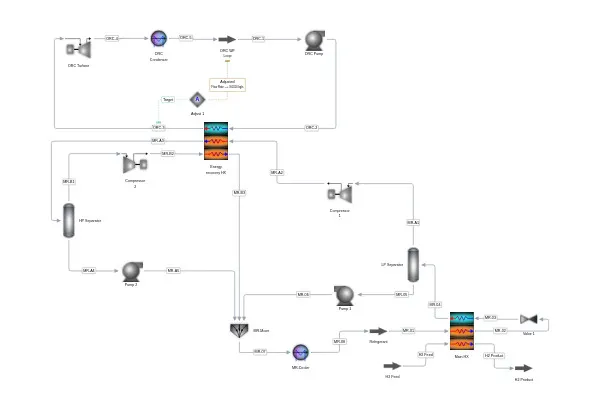
OpenHydrogen is cooled from near-ambient temperature to 225 K using a propane refrigeration cycle. The refrigeration system employs multiple pressure levels, phase separation and recycle to provide cooling over the required temperature range. Heat rejected from the propane cycle is partly recovered in an Organic Rankine Cycle (ORC) for power generation. The flowsheet illustrates integrated refrigeration, heat recovery and recycle operation relevant to hydrogen precooling and other low-temperature process applications.
 Open
Open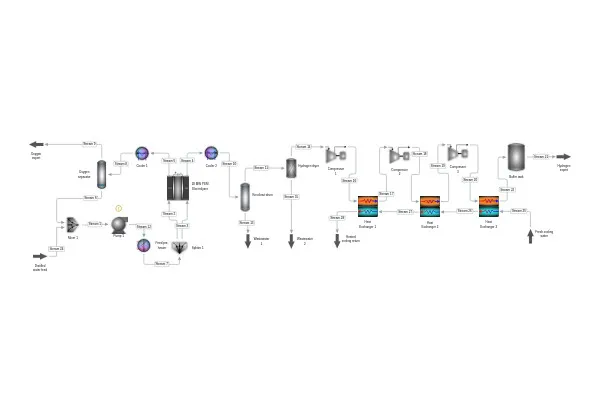
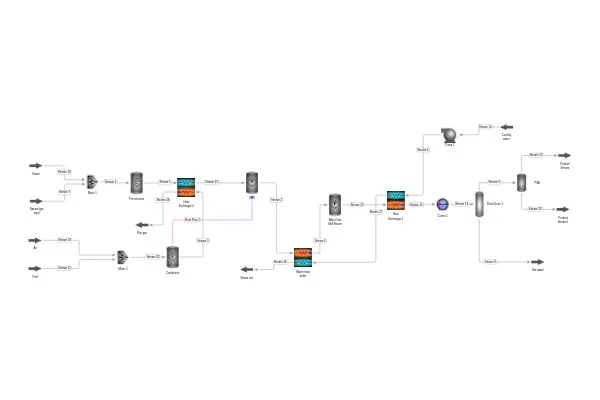
Steam reforming process for hydrogen production from natural gas. Natural gas is mixed with steam, pre-reformed, then reformed in an SMR reactor at 877°C (heated by a fuel/air combustor), followed by a water-gas shift reactor to convert CO to additional H2, cooling and condensate separation via a flash drum, and finally PSA purification to produce pure hydrogen. The process includes heat integration with a waste heat boiler for steam generation and flue gas heat recovery to preheat the reformer feed.
 Open
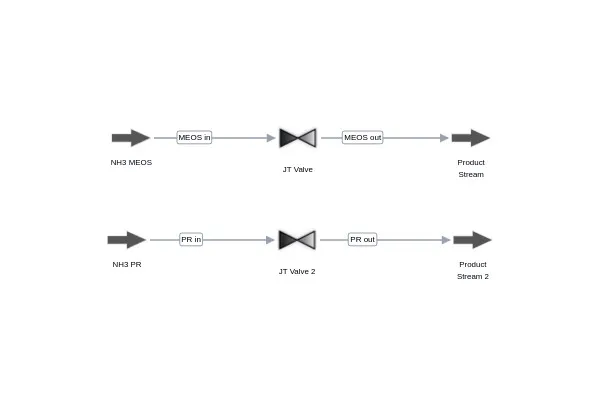
OpenThe sensitivity of Joule–Thomson expansion to the choice of equation of state for pure ammonia. The same inlet state and pressure reduction are evaluated using a multiparameter equation of state (MEOS) and the Peng–Robinson equation of state. Despite the simplicity of the process, the predicted outlet temperatures differ by approximately 13 K, illustrating how the thermodynamic model can have a substantial impact on process simulation results
 Open
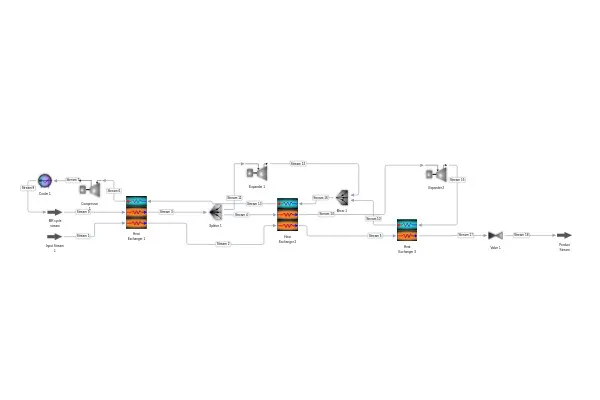
OpenA dual-expander nitrogen refrigeration cycle for LNG liquefaction: natural gas (55 bar, ~20°C) is progressively cooled through three heat exchangers and throttled to produce LNG, while the pure nitrogen refrigerant is split after the first heat exchanger — one stream expands at a warmer level and the other is cooled further before expanding at a colder level — then mixed and returned through the cold sides of the exchangers, improving cooling curve matching compared to the single-expander variant.
 Open
OpenA single nitrogen expander cycle for LNG liquefaction: high-pressure natural gas (55 bar, ~20°C) is cooled through two multi-stream heat exchangers and throttled via a JT valve to produce LNG, while a pure nitrogen refrigerant loop (compressor → aftercooler → warm HX → turboexpander → cold HX → back to warm HX) provides the refrigeration duty.
 Open
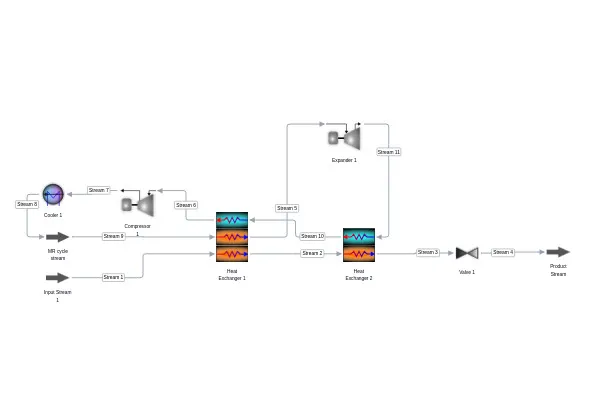
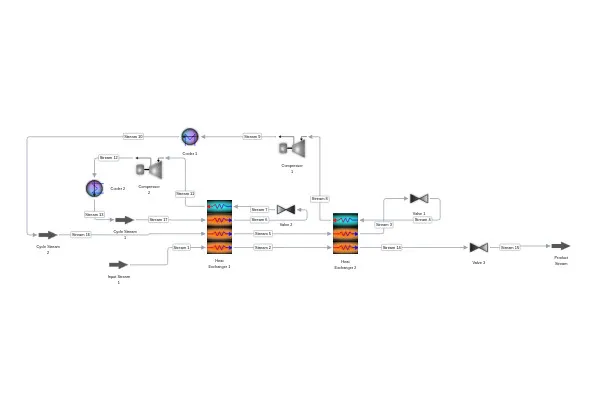
OpenDual Mixed Refrigerant (DMR) process for LNG production using two separate closed-loop mixed refrigerant cycles: a warm cycle (ethane/propane/butane) precools the natural gas feed to 236 K in the first multi-stream heat exchanger, and a cold cycle (methane/ethane/propane/isobutane/nitrogen) subcools it to 109 K in a second heat exchanger, before a final JT expansion valve produces LNG at ~1 bar. Each refrigerant loop has its own compressor and aftercooler.
 Open
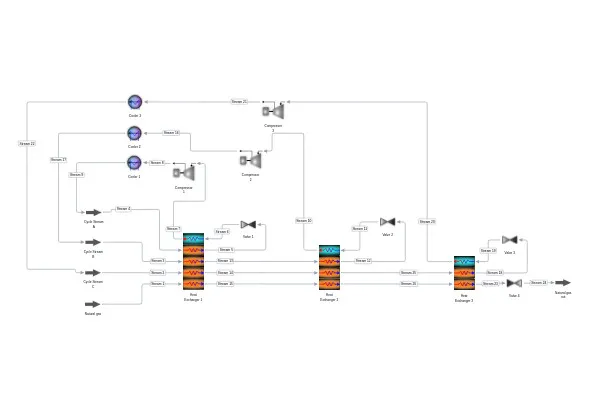
OpenMixed Fluid Cascade (MFC) LNG liquefaction process using three sequential mixed-refrigerant cycles (A: isobutane-rich for pre-cooling to ~233 K, B: ethane/propane-rich for liquefaction to ~188 K, C: methane/ethane-rich for sub-cooling to ~109 K), each with its own compressor, aftercooler, and JT valve. Natural gas at 60 bar is progressively cooled through three multi-stream heat exchangers in series to produce LNG.
 Open
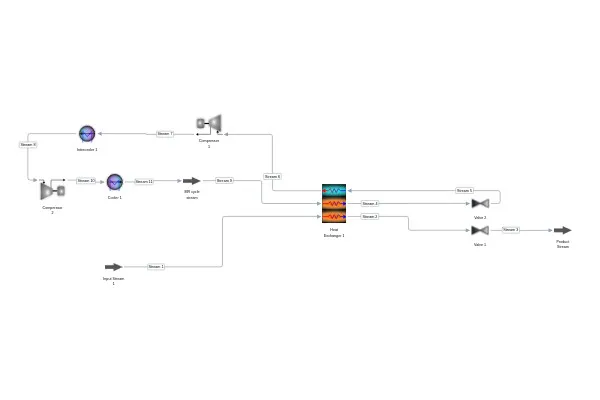
OpenA single mixed refrigerant (PRICO) LNG liquefaction process where natural gas (mostly methane) is cooled and liquefied to ~109 K in a multi-stream heat exchanger against a closed-loop mixed refrigerant (CH₄/C₂H₆/n-C₄H₁₀/N₂), then throttled through a JT valve to produce LNG at ~1 bar. The refrigerant loop includes two-stage compression with intercooling back to ambient temperature.
 Open
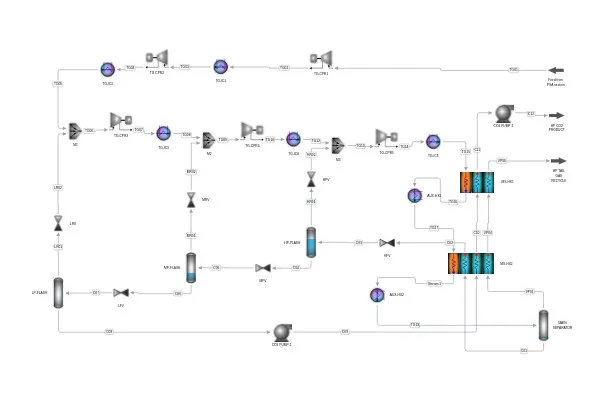
OpenLow-temperature CO₂ capture from a hydrogen-rich process gas. The feed is compressed in multiple stages with intercooling before entering a cryogenic separation section, where cooling, expansion and staged flashing are used to condense and separate CO₂. The captured liquid CO₂ is pumped to high pressure, while the remaining light gases are recycled or returned to the upstream process. The example illustrates multistage compression, cryogenic heat integration, phase separation, recycle and high-pressure CO₂ product conditioning.
 Open
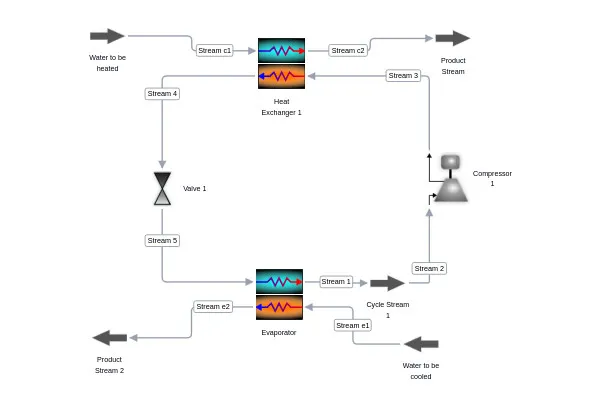
OpenHeat pumps transfer heat from a low-temperature heat source to a higher-temperature heat sink and are widely used for space and water heating, industrial heat recovery, and simultaneous heating and cooling. CO₂ (R744) is a natural refrigerant with attractive thermodynamic and environmental properties for many heat-pump applications. This example demonstrates a simple CO₂ vapor-compression heat pump in which CO₂ evaporates by absorbing heat from a water stream at approximately room temperature, thereby cooling the water. The refrigerant is then compressed to a higher pressure and temperature and transfers heat to a second water stream. After heat rejection, the CO₂ is expanded through a valve and returned to the evaporator, completing the cycle.
 Open
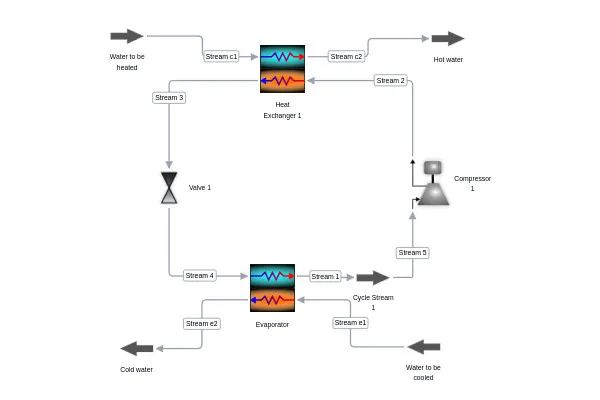
OpenHeat pumps transfer heat from a low-temperature heat source to a higher-temperature heat sink and are widely used for space and water heating, industrial heat recovery, and simultaneous heating and cooling. Mixed refrigerants can offer thermodynamic advantages over pure fluids, and zeotropic mixtures in particular may exhibit temperature glide during phase change, which can be beneficial in some heat-exchanger applications. This example demonstrates a simple vapor-compression heat pump using a mixed refrigerant consisting of 10% ethane and 90% propane. The refrigerant evaporates by absorbing heat from a water stream, thereby cooling the water, before being compressed to a higher pressure and temperature. It then transfers heat to a second water stream, is expanded through a valve, and returns to the evaporator to complete the cycle.
 Open
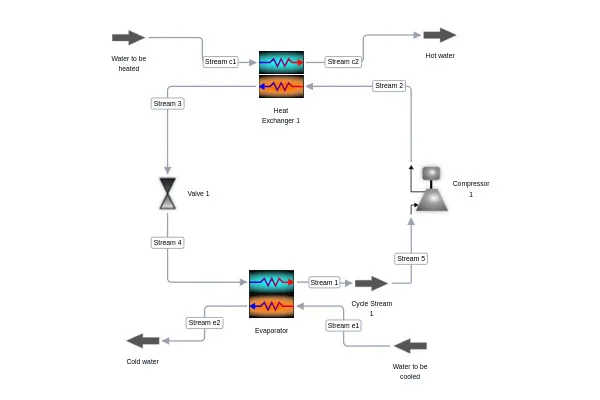
OpenHeat pumps transfer heat from a low-temperature heat source to a higher-temperature heat sink and are widely used for space and water heating, industrial heat recovery, and simultaneous heating and cooling. Propane (R290) is a natural refrigerant with favorable thermodynamic properties and is widely used in heat-pump and refrigeration applications. This example demonstrates a simple propane vapor-compression heat pump. Propane evaporates by absorbing heat from a water stream, thereby cooling the water, before being compressed to a higher pressure and temperature. The refrigerant then transfers heat to a second water stream, is expanded through a valve, and returns to the evaporator to complete the cycle.
 Open
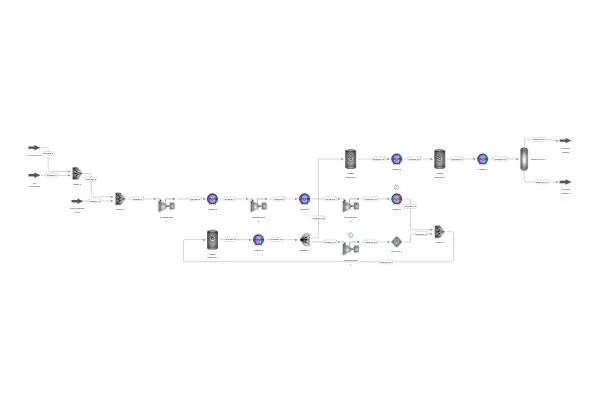
OpenThe TREMP (Topsoe Recycle Energy-efficient Methanation Process) converts synthesis gas containing H₂, CO and CO₂ into synthetic natural gas (SNG) through a series of adiabatic catalytic methanation reactors. Gas recycle and interstage cooling are used to control the large temperature rise caused by the highly exothermic reactions, while the released heat can be recovered for steam generation. The process demonstrates reactor sequencing.
 Open
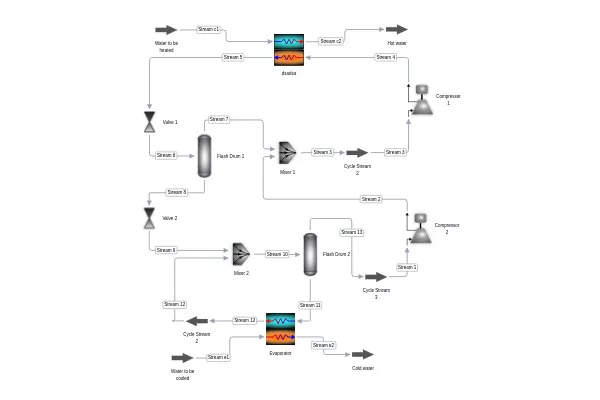
OpenHeat pumps transfer heat from a low-temperature heat source to a higher-temperature heat sink and are widely used for space and water heating, industrial heat recovery, and simultaneous heating and cooling. Ammonia (R717) is a natural refrigerant with excellent thermodynamic properties and is widely used in large industrial refrigeration and heat-pump systems. This example demonstrates a two-stage ammonia heat pump with a flooded evaporator and intermediate flash separation. In a flooded evaporator, excess liquid refrigerant is circulated through the evaporator so that the heat-transfer surface remains well wetted, while a separator separates the resulting vapor from the remaining liquid. This configuration is widely used in industrial ammonia systems because of its high heat-transfer performance. The refrigerant is compressed in two stages, reducing the pressure ratio across each compressor and enabling operation across a larger overall temperature lift. At high pressure, the ammonia transfers heat to the water to be heated before being expanded and returned through the lower-pressure parts of the cycle.
 Open
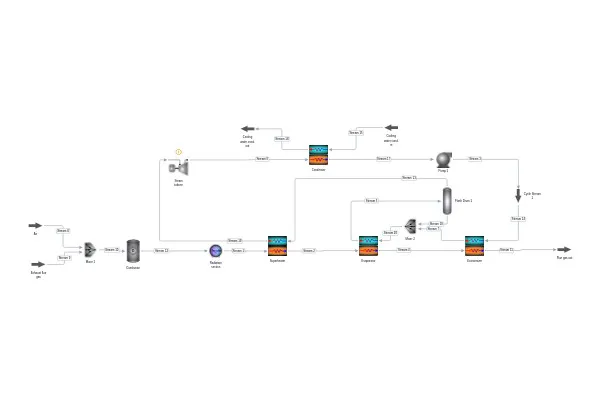
OpenThis example demonstrates waste heat recovery from the exhaust gas of a silicon production furnace using a water-based Rankine cycle. Heat from the high-temperature exhaust gas is recovered to generate and superheat steam, which is expanded through a turbine to produce power before being condensed and recirculated. The process illustrates heat integration, steam-cycle design and the conversion of industrial waste heat into useful power.
 Open
Open23 examples